NR Series BATTERY / CHARGING CHARGING SYSTEM Noise Occurs from V-ribbed Belt or Generator Assembly
PROCEDURE
Confirm the problem symptom.
- Result:
Symptom Proceed to Noise occurs from V-ribbed belt A Noise occurs from generator assembly B
A
B
Check the V-ribbed belt for wear or damage.
- OK:
The V-ribbed belt is not worn or damaged.
- Result:
Proceed to OK NG
OK
NG
Check the grooves of the generator pulley with clutch for wear or damage.
- OK:
The grooves of the generator pulley with clutch are not worn or damaged.
- Result:
Proceed to OK NG
OK
NG
Start the engine and check the generator pulley with clutch for looseness.
- OK:
The generator pulley with clutch is not loose.
- Result:
Proceed to OK NG
OK
NG
Check the installation condition of the generator pulley cap.
- OK:
The generator pulley cap is not loose or missing.
Check for forming of particles due to friction (for dry type pulley) or grease leaks (for wet type pulley).
- OK:
There are no large amounts of particles (for dry type pulley) or grease leaks (for wet type pulley).
Check the generator pulley with clutch for misalignment (interference with the generator assembly).
- OK:
The generator pulley with clutch is not misaligned (no interference with the generator assembly).
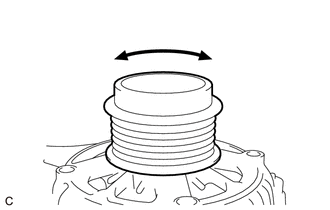
Turn the generator pulley with clutch clockwise and counterclockwise by hand and check for noise.
- OK:
Noise does not occur when turned in either direction.
Turn the generator pulley with clutch clockwise and counterclockwise by hand and visually check for runout.
- OK:
The generator pulley with clutch does not have runout.
Inspect the generator pulley with clutch.
- Result:
Proceed to OK NG
OK
NG
Perform a road test and check that noise does not occur when decelerating.
- OK:
Noise does not occur.
Stop the engine and check that generator pulley with clutch noise does not occur as the engine stops.
- OK:
Noise does not occur.
- Result:
Proceed to OK NG
OK
NG
Inspect the generator pulley with clutch.
- Result:
Proceed to OK NG
OK
NG