K121 CVT CONTINUOUSLY VARIABLE TRANSAXLE SYSTEM P072012 Output Speed Sensor Circuit Short to Battery P072014 Output Speed Sensor Circuit Short to Ground or Open P072031 Output Speed Sensor No Signal
DESCRIPTION
The transmission revolution sensor (NOUT) detects the output shaft speed and sends it to the ECM.
The ECM determines if belt mode has been entered by comparing the transmission revolution sensor (NOUT) and (NSS) signals.
| DTC No. | Detection Item | DTC Detection Condition | Trouble Area | MIL | DTC Output from | Priority | Note |
|---|---|---|---|---|---|---|---|
| P072012 | Output Speed Sensor Circuit Short to Battery | The transmission revolution sensor (NOUT) signal is normal but the transmission revolution sensor (NOUT) output voltage is higher than 1.8 V for 4.5 seconds or more (1-trip detection logic). | ·
Wire harness or connector ·
Transmission revolution sensor (NOUT) ·
ECM |
Comes on | Engine | A | SAE Code:
P077D |
| P072014 | Output Speed Sensor Circuit Short to Ground or Open | The transmission revolution sensor (NOUT) signal is normal but the transmission revolution sensor (NOUT) output voltage is less than 0.2 V for 4.5 seconds or more (1-trip detection logic). | ·
Wire harness or connector ·
Transmission revolution sensor (NOUT) ·
ECM |
Comes on | Engine | A | SAE Code:
P077C |
| P072031 | Output Speed Sensor No Signal | Any of the following conditions are met for 5 seconds or more (1-trip detection logic):
·
When the transmission revolution sensor (NSS) signal indicates 350 rpm or more and the SPD signal indicates 11 km/h (7 mph) or more, the transmission revolution sensor (NOUT) signal indicates less than 300 rpm. ·
When the transmission revolution sensor (NC1) signal indicates 1180 rpm or more and the SPD signal indicates 11 km/h (7 mph) or more, the transmission revolution sensor (NOUT) signal indicates less than 300 rpm. |
·
Wire harness or connector ·
Transmission revolution sensor (NOUT) ·
ECM |
Comes on | Engine | A | SAE Code:
P0722 |
MONITOR DESCRIPTION
The ECM receives signals from the transmission revolution sensor (NOUT) installed to the continuously variable transaxle and determines the output shaft speed in order to control the gear ratio.
If the ECM detects no signal from the transmission revolution sensor (NOUT) even while the vehicle is being driven, it will determine that the transmission revolution sensor (NOUT) is malfunctioning, illuminate the MIL and store a DTC.
CONFIRMATION DRIVING PATTERN
- CAUTION:
-
When performing the confirmation driving pattern, obey all speed limits and traffic laws.
- HINT:
- ·
After repairs have been completed, clear the DTCs and then check that the vehicle has returned to normal by performing the following All Readiness check procedure.
·When clearing the permanent DTCs, refer to the Clear Permanent DTC procedure.
Clear the DTCs (even if no DTCs are stored, perform the clear DTC procedure).
Turn the ignition switch off and wait for 2 minutes or more.
Perform the D Position Shift Test inspection in Road Test. [*1]
- HINT:
-
[*1]: Normal judgment procedure.
-
The normal judgment procedure is used to complete DTC judgment and also used when clearing permanent DTCs.
Stop the vehicle.
Enter the following menus: Powertrain / Engine / Utility / All Readiness.
Input the DTC: P072012, P072014 or P072031.
Check the DTC judgment result.
| GTS Display | Description |
|---|---|
| NORMAL | ·
DTC judgment completed ·
System normal |
| ABNORMAL | ·
DTC judgment completed ·
System abnormal |
| INCOMPLETE | ·
DTC judgment not completed ·
Perform driving pattern after confirming DTC enabling conditions |
| N/A | ·
Unable to perform DTC judgment ·
Number of DTCs which do not fulfill DTC preconditions has reached ECU memory limit |
- HINT:
- ·
If the judgment result shows NORMAL, the system is normal.
·If the judgment result shows ABNORMAL, the system has a malfunction.
·If the judgment result shows INCOMPLETE or N/A, perform the normal judgment procedure again.
WIRING DIAGRAM
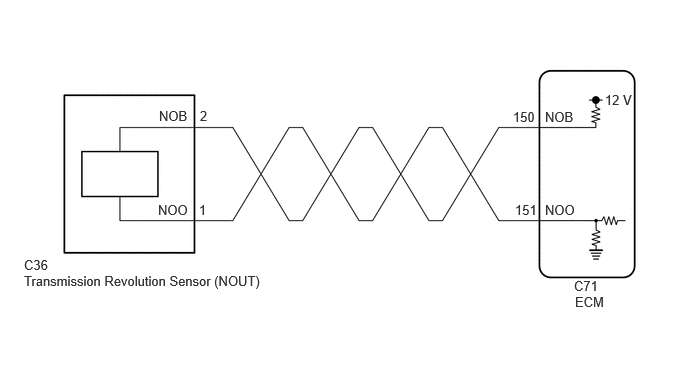
CAUTION / NOTICE / HINT
- CAUTION:
- ·
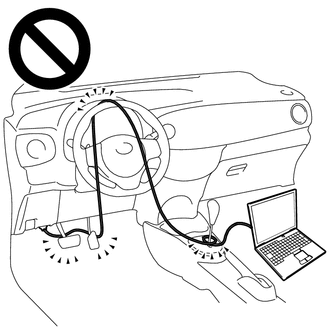
Strictly observe posted speed limits, traffic laws and road conditions.
·Do not drive the vehicle with the cable of the GTS contacting the pedals, shift lever or steering wheel.
·Driving the vehicle with the cable of the GTS contacting these areas could impede vehicle control, resulting in a serious accident.
- ·
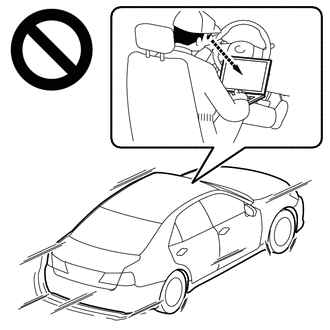
Do not operate the GTS while driving the vehicle.
·Operating the GTS while driving the vehicle will prevent you from paying sufficient attention to vehicle surroundings, and could result in a serious accident.
- NOTICE:
- ·
Perform the universal trip to clear permanent DTCs.
·Perform registration and/or initialization when parts related to the continuously variable transaxle system are replaced.
·Check that no DTCs are stored after performing initialization.
PROCEDURE
According to the display on the GTS, read the Data List.
- Powertrain > Engine > Data List
-
Tester Display Measurement Item Range Normal Condition Diagnostic Note NO Sensor Voltage Transmission revolution sensor (NOUT) output voltage Min.: 0.000 V
Max.: 4.999 V0.2 to 1.8 V: Engine idling (Vehicle stopped with shift lever in P or N) -
- Powertrain > Engine > Data List
-
Tester Display NO Sensor Voltage - 50003 372 928
- Result:
Result Proceed to The value of NO Sensor Voltage is between 0.2 and 1.8 V A None of the above conditions are met B
A
B
According to the display on the GTS, read the Data List.
- Powertrain > Engine > Data List
-
Tester Display Measurement Item Range Normal Condition Diagnostic Note NO Sensor Speed Output shaft speed (NOUT) Min.: 0 rpm
Max.: 65535 rpm0 rpm: Vehicle stopped -
- Powertrain > Engine > Data List
-
Tester Display NO Sensor Speed - 50003 372 927
- Result:
Result Proceed to The value of NO Sensor Speed is 0 rpm A None of the above conditions are met B
A
B
According to the display on the GTS, read the Data List.
- Powertrain > Engine > Data List
-
Tester Display Measurement Item Range Normal Condition Diagnostic Note NSS Sensor Speed Secondary pulley speed (NSS) Min.: 0 rpm
Max.: 65535 rpmEqual to NO Sensor Speed: Vehicle being driven in belt mode - NO Sensor Speed Output shaft speed (NOUT) Min.: 0 rpm
Max.: 65535 rpmEqual to NSS Sensor Speed: Vehicle being driven in belt mode - Shift Mode Shift mode status Gear Mode or Belt Mode - -
- Powertrain > Engine > Data List
-
Tester Display NSS Sensor Speed NO Sensor Speed Shift Mode - 50003 372 925,927,938
- Result:
Result Proceed to The value of NSS Sensor Speed and NO Sensor Speed are the same A The value of NSS Sensor Speed and NO Sensor Speed are different B
A
B
- HINT:
-
for M20C-FKS:
-
for M20D-FKS:
- Result:
Proceed to NEXT
NEXT
for Registration: Click hereDrivetrain>K121 (CVT)>CONTINUOUSLY VARIABLE TRANSAXLE SYSTEM>REGISTRATION202304,999999,_52,_138176,_0584691,RM1000000029HF6,
for Initialization: Click hereDrivetrain>K121 (CVT)>CONTINUOUSLY VARIABLE TRANSAXLE SYSTEM>INITIALIZATION202304,202405,_52,_138176,_0584691,RM1000000029HF7,202405,202409,_52,_138176,_0584691,RM100000002JGMX,202409,999999,_52,_138176,_0584691,RM100000002NRHB,
- Result:
Proceed to OK NG
OK
NG
Pre-procedure1
Disconnect the C36 transmission revolution sensor (NOUT) connector.
Disconnect the C71 ECM connector.
Procedure1
Measure the resistance according to the value(s) in the table below.
- Standard Resistance:
Tester Connection Condition Specified Condition C36-1 (NOO) - C71-151 (NOO) Always Below 1 Ω C36-2 (NOB) - C71-150 (NOB) Always Below 1 Ω C36-1 (NOO) or C71-151 (NOO) - Body ground and other terminals Always 10 kΩ or higher C36-2 (NOB) or C71-150 (NOB) - Body ground and other terminals Always 10 kΩ or higher
- Result:
Proceed to OK NG
Post-procedure1
Connect the C71 ECM connector.
Connect the C36 transmission revolution sensor (NOUT) connector.
OK
NG
- HINT:
-
for M20C-FKS:
-
for M20D-FKS:
- Result:
Proceed to NEXT
NEXT
for Registration: Click hereDrivetrain>K121 (CVT)>CONTINUOUSLY VARIABLE TRANSAXLE SYSTEM>REGISTRATION202304,999999,_52,_138176,_0584691,RM1000000029HF6,
for Initialization: Click hereDrivetrain>K121 (CVT)>CONTINUOUSLY VARIABLE TRANSAXLE SYSTEM>INITIALIZATION202304,202405,_52,_138176,_0584691,RM1000000029HF7,202405,202409,_52,_138176,_0584691,RM100000002JGMX,202409,999999,_52,_138176,_0584691,RM100000002NRHB,