SUPPLEMENTAL RESTRAINT SYSTEMS AIRBAG SYSTEM(for NR Series Engine) PRECAUTION
- CAUTION:
-
Failure to carry out service procedures in the correct sequence could cause SRS parts to unexpectedly deploy and possibly lead to serious injuries. Furthermore, if a mistake is made when servicing SRS parts, they may fail to operate when required. Before performing servicing (including installation/removal, inspection and replacement of parts), be sure to read the following precautions.
If a mistake is made when servicing SRS parts, they may fail to operate when required. Before performing service (including installation/removal, inspection and replacement of parts), be sure to read the following precautions.
Airbag sensor with ECU assembly
Front airbag sensor
Side airbag pressure sensor
Side No. 2 airbag sensor
Horn button assembly
Lower No. 1 instrument panel airbag assembly
Instrument panel passenger airbag assembly
Curtain shield airbag assembly
Front seat airbag assembly
Front seat cushion airbag assembly RH
Front seat inner belt assembly
Front seat outer belt assembly
Rear 3 point type seat outer belt assembly
PRECAUTION FOR DISCONNECTING CABLE FROM NEGATIVE BATTERY TERMINAL
When troubleshooting the SRS, always check for DTCs before disconnecting the cable from the negative (-) battery terminal.
After turning the ignition switch off, disconnect the cable from the negative (-) battery terminal.
- NOTICE:
-
After the ignition switch is turned off, there may be a waiting time before disconnecting the negative (-) battery terminal.
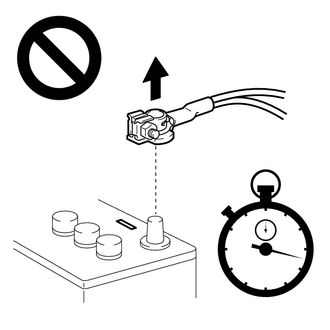
Before starting work relating to the SRS airbag system, fitting adjustment of the front/rear doors and removal, installation or replacement of parts near the airbag sensors, wait for at least 90 seconds after disconnecting the cable from the negative (-) battery terminal.
- CAUTION:
-
The SRS is equipped with a back-up power source. If work is started within 90 seconds of disconnecting the cable from the negative (-) battery terminal, the SRS parts may deploy.
- HINT:
-
When disconnecting and reconnecting the battery, there is an automatic learning function that completes learning when the respective system is used.
GENERAL PRECAUTION
Information labels are attached to the SRS parts. Follow the instructions on the labels.
Never disassemble or attempt to repair any of the SRS parts.
If any of the SRS parts are dropped, or if any cracks, dents or other defects are found, replace them with new parts.
Never use SRS parts from another vehicle. When replacing parts, use new parts.
Do not expose any of the SRS parts directly to high temperatures or flames.
If the vehicle has been involved in a minor collision where the SRS did not deploy, the SRS parts should be inspected before further use of the vehicle.
Do not apply grease, detergent, oil or water to the SRS parts. If applied, immediately wipe it off with a dry cloth.
When deploying or storing the SRS parts, avoid places with a high temperature (ambient temperature of 93°C (199°F) or higher for an airbag and 80°C (176°F) or higher for a pretensioner) and high humidity, and keep them away from electrical noise.
Do not stack or place anything on top of the SRS parts.
- CAUTION:
-
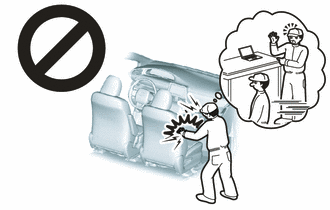
-
Dispose of the airbags according to the disposal procedures for each airbag.
Never measure the resistance of the SRS parts.
- CAUTION:
-
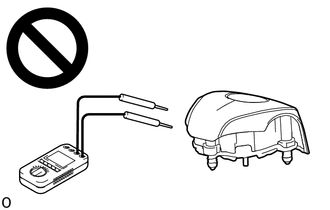
-
Never measure the resistance of the SRS parts because current from the tester may cause the SRS parts to deploy.
Use a voltmeter/ohmmeter with high impedance (minimum = 10 kΩ) for troubleshooting electrical circuits.
Be sure to check the SRS warning light and multi-information display after checking, removing and installing, or replacing the airbag and sensor.
PRECAUTION FOR HORN BUTTON ASSEMBLY, LOWER NO. 1 INSTRUMENT PANEL AIRBAG ASSEMBLY, INSTRUMENT PANEL PASSENGER AIRBAG ASSEMBLY, CURTAIN SHIELD AIRBAG ASSEMBLY, FRONT SEAT AIRBAG ASSEMBLY AND FRONT SEAT CUSHION AIRBAG ASSEMBLY RH
Keep the deployment side of an airbag facing upward even when the airbag is temporarily removed during service.
- CAUTION:
-
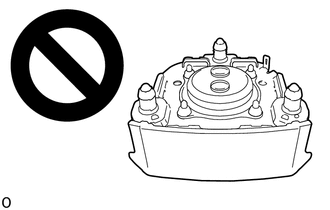
-
Always place a removed or a new airbag with the deployment side facing upward. Placing the airbag with the deployment side facing downward could cause a serious accident if the airbag deploys.
When storing an airbag, do not place anything on top of it or place it in a pile.
PRECAUTION FOR FRONT SEAT OUTER BELT ASSEMBLY (PRETENSIONER) AND REAR 3 POINT TYPE SEAT OUTER BELT ASSEMBLY (PRETENSIONER)
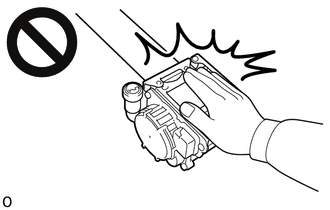
Do not touch the area around the retractor, even when a front seat outer belt assembly or rear 3 point type seat outer belt assembly is temporarily removed during service.
- CAUTION:
-
-
If the pretensioner unexpectedly deploys and the front seat outer belt assembly or rear 3 point type seat outer belt assembly is retracted during an operation, it could cause a serious accident.
When storing a pretensioner, do not place objects on top of it or place it in a pile.
PRECAUTION FOR SPIRAL CABLE WITH SENSOR SUB-ASSEMBLY
Do not remove/install the spiral cable with sensor sub-assembly with the battery connected and the ignition switch ON.
Do not rotate the spiral cable with sensor sub-assembly without the steering wheel assembly installed, with the battery connected and the ignition switch ON.
Ensure that the steering wheel assembly is installed and aligned straight when inspecting the steering sensor.
When rotating the spiral cable with sensor sub-assembly, make sure to push on the interlock to release the interlock mechanism.
Removing the steering sensor from the spiral cable sub-assembly without using a lock pin may result in a misaligned center position of the steering sensor. Therefore, make sure to use the lock pin provided with a new spiral cable sub-assembly when removing the steering sensor from the spiral cable sub-assembly.
Be sure that the spiral cable with sensor sub-assembly is in the neutral position during installation and when removing and installing the steering wheel assembly.
- NOTICE:
-
If the steering wheel assembly is turned without the spiral cable with sensor sub-assembly installed in the neutral position, the cable may break.
PRECAUTION FOR AIRBAG SENSORS
When the SRS parts are deployed (including when only an airbag or pretensioner is deployed) due to a collision, be sure to replace all sensors in the damaged areas (anywhere in need of repair) and the airbag sensor with ECU assembly.
Visually check the airbag sensors in undamaged areas for defects.
The defects are as follows:
Cracks in the sensor housing
Dents in the sensor housing
Chips in the sensor housing
Cracks or other damage to the connector
Damage to the serial number
- OK:
No defects are found.
If any defects are found or an airbag sensor has detected a major collision, replace the airbag sensor with a new one.
When disconnecting or reconnecting a connector of the airbag sensor with ECU assembly, front airbag sensor, side airbag pressure sensor and side No. 2 airbag sensor connectors, make sure to do so with the sensor installed to the vehicle.
If a sensor has been dropped make sure to replace it with a new one.
If a sensor has been subjected to strong impact make sure to replace it with a new one.
Never disassemble any of the SRS parts.
PRECAUTION WHEN REPLACING AIRBAG SENSOR WITH ECU ASSEMBLY
When the airbag sensor with ECU assembly is replaced, perform initialization.
for CVT (K313): Click hereDrivetrain>K313 (CVT)>CONTINUOUSLY VARIABLE TRANSAXLE SYSTEM>INITIALIZATION201906,999999,_52,_080728,_0392261,RM100000001HP98,
for Electronically Controlled Brake System: Click hereBrake>BRAKE CONTROL / DYNAMIC CONTROL SYSTEMS>ELECTRONICALLY CONTROLLED BRAKE SYSTEM (for Gasoline Model (NR Series))>UTILITY202304,999999,_54,_080770,_0599814,RM100000002BA8F,
for Stop and Start System: Click hereEngine / Hybrid System>STOP AND START>STOP AND START SYSTEM>REGISTRATION201906,999999,_51,_080774,_0393362,RM100000001HXHH,
PRECAUTION FOR WIRE HARNESS AND CONNECTOR
All wire harnesses except unexposed harnesses in the engine compartment are colored yellow.
As special connectors are used, be careful when handling them.
WHEN SERVICING DAMAGED VEHICLE
Before using an electric welder on the vehicle, remove any SRS parts around the area being repaired.
Before repairs, remove the airbag sensor assemblies/airbag sensor with ECU assembly if impacts are likely to be applied to the sensor during repairs.
Never expose an airbag sensor directly to high temperatures.
As the SRS parts are very hot after being deployed, ensure that all wire harnesses and connectors around deployed SRS parts are not damaged.
PRECAUTION FOR SIDE AIRBAG PRESSURE SENSOR
Do not make any modifications to the front door that may change the inner pressure of the front door.
Do not allow any foreign matter to enter the side airbag pressure sensor as it may affect the pressure detection performance of the sensor.
When painting the front door, remove or apply protective tape to the side airbag pressure sensor to prevent paint from attaching to it.
Make sure that the parts which maintain the sealing performance of the front door are securely installed. If the sealing performance of the front door decreases, the pressure detection performance of the side airbag pressure sensor may be affected. Repair or replace parts as necessary.
CONDITIONS WHEN INSPECTION OF SRS PARTS IS NECESSARY
When the vehicle is damaged in a collision, even if the SRS parts are not deployed.
When SRS system DTCs are output.