TIRE / WHEEL TIRE AND WHEEL SYSTEM INSPECTION
PROCEDURE

 1.INSPECT TIRES
Check the tires for wear and proper inflation pressure.
- Specified Pressure (When Tire is Cool):
Tire Size Model Front
kPa (kgf/cm2, psi)Rear
kPa (kgf/cm2, psi)*: Can be used only when there are 5 or less passengers
215/70R16C 108/106T for Van 350 (3.5, 51) 375 (3.75, 54) for Commuter 325 (3.25, 47) 235/65R16C 115/113T for Commuter 325 (3.25, 47) 425 (4.25, 62) 235/60R17 109/107LT for Wagon 325 (3.25, 47) 375 (3.75, 54) 300 (3.0, 44)* 300 (3.0, 44)*
Tire pressure adjustment method when warm (w/ Tire Pressure Warning System):
Turn the ignition switch off.
Connect the GTS to the DLC3.
Turn the ignition switch to ON.
Turn the GTS on.
Enter the following menus: Chassis / Tire Pressure Monitor / Data List.
Adjust the tire pressure so that the displayed value is equal to the set pressure.
Perform initialization and check that initialization completes.
Check and record the value of the Data List item "Temperature in Tire". (Ts)
Check and record the ambient temperature during tire pressure adjustment. (Tm)
Readjust the tire pressure according to the difference between the tire internal temperature (Ts) and the ambient temperature (Tm). (P)
- HINT:
-
Tire internal temperature: Ts, Ambient temperature: Tm, Tire pressure readjustment value: P
-
P = (Specified Pressure) + (Ts - Tm)
Check the pressure adjustment value with the Data List item "Tire Inflation Pressure".
- Chassis > Tire Pressure Monitor > Data List
-
Tester Display ID 1 Tire Inflation Pressure ID 2 Tire Inflation Pressure ID 3 Tire Inflation Pressure ID 4 Tire Inflation Pressure ID 5 Tire Inflation Pressure - 50003 203 36,37,38,39,40
- NOTICE:
-
Check the tire pressure warning system for the relationship between the inflation pressure and tire pressure warning pressure.
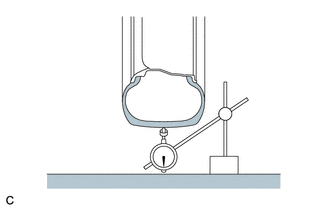
Using a dial indicator, check the runout of the tires.
- Maximum tire runout:
3.0 mm (0.118 in.)
- HINT:
-
Remove the wheel assembly from the vehicle, and measure the wheel assembly alone.
2.ROTATE TIRES
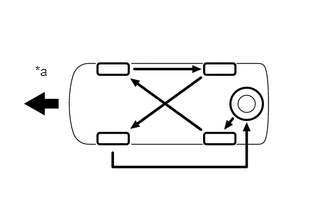
| *a | Front of the Vehicle |
Remove the wheel assembly.
Click hereSuspension>TIRE / WHEEL>TIRE AND WHEEL>REMOVAL201902,999999,_53,_079312,_0387328,RM100000001GWFZ,
Rotate the tires as shown in the illustration.
Install the wheel assembly.
- HINT:
-
When a tire rotation is performed on a vehicle that has different specified tire pressures for the front and rear of the vehicle, it is necessary to perform initialization for the tire pressure warning system
3.INSPECT WHEEL BALANCE
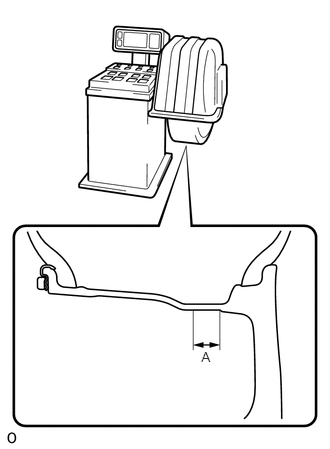
for Aluminum Wheel Type:
Check and adjust the off-the-car balance.
- Maximum Imbalance After Adjustment:
15 g (0.033 lb)
- NOTICE:
- ·
Use a cleaning detergent to remove dirt, oil and water from the surface where the balance weight is to be adhered.
·Do not touch the sticking surface of the tape.
·Adhere a sticking type balance weight to the flat surface (A) shown in the illustration.
- Width (A):
25 mm (0.984 in.)
·Push the balance weight firmly to adhere it to the position.
·Do not reuse the balance weight.
·Please use the Toyota genuine sticking type balance weight.
- HINT:
- ·
The inner side balance weights should be installed by clipping them to the rim.
·If the tires vibrate even after off-the-car balance adjustment, adjust the wheel balance with on-the-car balancing as necessary.
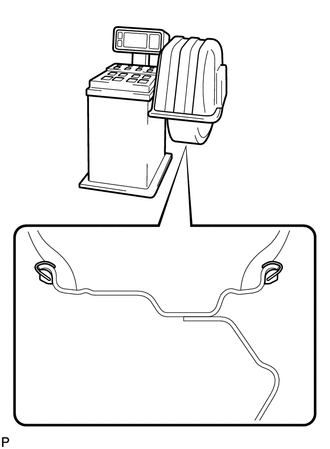
for Steel Wheel Type:
Check and adjust the off-the-car balance.
- Maximum Imbalance After Adjustment:
Tire Size Maximum Imbalance After Adjustment 215/70R16C 108/106T 15 g (0.033 lb) 235/65R16C 115/113T
- HINT:
-
If the tires vibrate even after off-the-car balance adjustment, adjust the wheel balance with on-the-car balancing as necessary.
4.INSPECT FRONT AXLE HUB BEARING LOOSENESS
5.INSPECT FRONT AXLE HUB RUNOUT
6.INSPECT REAR AXLE SHAFT