7GR-FKS FUEL FUEL SYSTEM ON-VEHICLE INSPECTION
PROCEDURE

 1.CHECK FUEL PUMP OPERATION AND INSPECT FOR FUEL LEAK
Check fuel pump operation.
Connect the GTS to the DLC3.
Turn the ignition switch to ON.
- NOTICE:
-
Do not start the engine.
Turn the GTS on.
Enter the following menus: Powertrain / Engine / Active Test / Activate the Circuit Relay.
- Powertrain > Engine > Active Test
-
Tester Display Activate the Circuit Relay - 50004 372 40
Check for pressure in the fuel tube sub-assembly from the fuel line. Check that sounds of fuel flowing from the fuel tank assembly can be heard. If no sounds can be heard, check the relay, fuel pump, ECM and wiring connectors.
Inspect for fuel leaks.
Check that there are no fuel leaks from the fuel system after doing any maintenance or repairs. If there is a fuel leak, repair or replace parts as necessary.
Turn the engine switch off.
Disconnect the GTS from the DLC3.
2.CHECK FUEL PRESSURE
Discharge fuel system pressure.
Measure the battery voltage.
- Standard Voltage:
11 to 14 V
Disconnect the cable from the negative (-) battery terminal.
- NOTICE:
- ·
After turning the ignition switch is turned off, there may be a waiting time before disconnecting the negative (-) battery terminal.
·When disconnecting and reconnecting the negative (-) battery terminal.
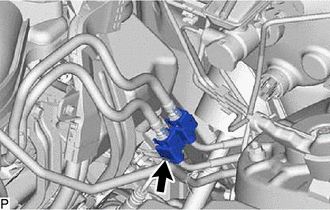
Remove the No. 2 fuel pipe clamp.
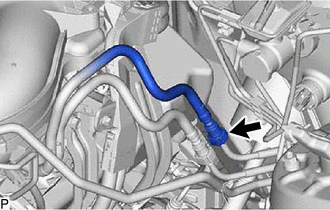
Disconnect the fuel tube sub-assembly (for Port Injection).

Disconnect the fuel tube sub-assembly (for Direct Injection).
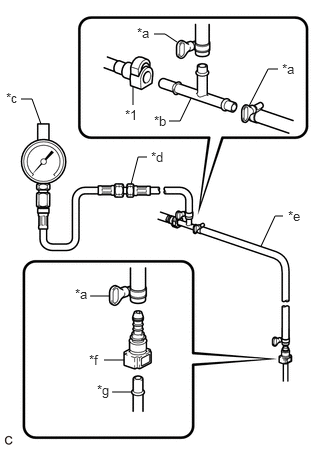
| *1 | Fuel Tube Sub-assembly (Vehicle Side) |
| *a | SST (Hose Band) |
| *b | SST (T-joint) |
| *c | SST (Gauge) |
| *d | SST (Hose Joint) |
| *e | SST (Hose) |
| *f | SST (Fuel Tube Connector) |
| *g | Fuel Pipe (Vehicle Side) |
Install SST (EFI fuel pressure gauge) as shown in the illustration.
- SST
- 09268-45101 (09268-41250, 09268-41260, 09268-41280, 09268-41500, 09268-41700, 95336-08070)
Wipe up any spilled fuel.
Connect the cable to the negative (-) battery terminal.
Connect the GTS to the DLC3.
Turn the ignition switch to ON.
- NOTICE:
-
Do not start the engine.
Turn the GTS on.
Enter the following menus: Powertrain / Engine / Active Test / Activate the Circuit Relay.
- Powertrain > Engine > Active Test
-
Tester Display Activate the Circuit Relay - 50004 372 40
Measure the fuel pressure.
- Standard Fuel Pressure:
196 to 833 kPa (2.0 to 8.5 kgf/cm2, 28 to 121 psi)
If the fuel pressure is more than the standard, replace the fuel main valve assembly.
If the fuel pressure is less than the standard, check the fuel hoses and their connections, fuel pump with filter assembly, fuel filter (fuel suction plate sub-assembly) and fuel main valve assembly.
Disconnect the GTS from the DLC3.
Start the engine.
Measure the fuel pressure at idle.
- Standard Fuel Pressure:
196 to 833 kPa (2.0 to 8.5 kgf/cm2, 28 to 121 psi)
- HINT:
-
Refer to Standard Idle Speed.
Stop the engine.
Check that the fuel pressure remains as specified for 5 minutes.
- Standard Fuel Pressure:
98 kPa (1.0 kgf/cm2, 14.2 psi) or more
If the result is not as specified, check the fuel pump with filter assembly, fuel main valve assembly and/or fuel injector assemblies.
After checking the fuel pressure, disconnect the cable from the negative (-) battery terminal and carefully remove SST to prevent fuel from spraying.
- NOTICE:
-
When disconnecting and reconnecting the negative (-) battery terminal.
- HINT:
-
When disconnecting and reconnecting the battery, there is an automatic learning function that completes learning when the respective system is used.
Connect the fuel tube sub-assembly (for Direct Injection).
Connect the fuel tube sub-assembly (for Port Injection).
Install the No. 2 fuel pipe clamp.
Inspect for fuel leaks.
3.CHECK FUEL PRESSURE (for High Pressure)
Connect the GTS to the DLC3.
Turn the ignition switch to ON.
Turn the GTS on.
Enter the following menus: Powertrain / Engine / Data List / Engine Speed, Coolant Temperature, Fuel Pressure (High) and Injection Mode.
- Powertrain > Engine > Data List
-
Tester Display Engine Speed Coolant Temperature Fuel Pressure (High) Injection Mode - 50003 372 211,205,265,294
Check the high pressure side fuel pressure at idle (shift lever in N, engine warmed up and A/C off).
- Standard Fuel Pressure:
1800 to 2800 kPa (18.4 to 28.6 kgf/cm2, 261 to 406 psi)
If the result is not as specified, check the fuel pump, fuel pump assembly, fuel pressure sensor and wire harnesses.
Stop the engine.