M20F-FXS, M20G-FXS ENGINE CONTROL SFI SYSTEM P012F62 Engine Coolant Temperature/Engine Oil Temperature Signal Compare Failure
DESCRIPTION
The engine is equipped with an engine coolant temperature sensor and an engine oil temperature sensor (engine oil pressure and temperature sensor). The engine coolant temperature sensor and engine oil temperature sensor (engine oil pressure and temperature sensor) each have a built-in thermistor. As the temperature decreases, the thermistor resistance increases and as the temperature increases, the thermistor resistance decreases. The voltages at the respective terminals of the ECM change in accordance with the changes in the resistance of the thermistors. The ECM performs control based on these voltages.
| DTC No. | Detection Item | DTC Detection Condition | Trouble Area | MIL | Note |
|---|---|---|---|---|---|
| P012F62 | Engine Coolant Temperature/Engine Oil Temperature Signal Compare Failure | All of the following conditions are met (2 trip detection logic):
1.
The auxiliary battery voltage is higher than 8 V. 2.
5 hours or more have elapsed since the engine stopped on the previous trip. 3.
The engine oil temperature is -10°C (14°F) or higher. 4.
The engine coolant temperature is -10°C (14°F) or higher. 5.
The difference between the readings of the engine coolant temperature and engine oil temperature is higher than 20°C (36°F). |
·
Engine coolant temperature sensor ·
Engine oil temperature sensor (engine oil pressure and temperature sensor) ·
ECM |
Comes on | SAE Code: P012F |
MONITOR DESCRIPTION
After the engine has stopped for 5 hours or more, the ECM monitors the voltage of the engine coolant temperature sensor and engine oil temperature sensor (engine oil pressure and temperature sensor). If the difference between the readings of the engine coolant temperature and engine oil temperature is higher than 20°C (36°F), the ECM determines that there is a malfunction in the engine coolant temperature sensor circuit or engine oil temperature sensor (engine oil pressure and temperature sensor) circuit, and stores a DTC and illuminates the MIL.
MONITOR STRATEGY
| Required Sensors/Components | Engine coolant temperature sensor
Engine oil temperature sensor |
| Frequency of Operation | Once per driving cycle |
CONFIRMATION DRIVING PATTERN
- HINT:
- ·
After repair has been completed, clear the DTC and then check that the vehicle has returned to normal by performing the following All Readiness check procedure.
·When clearing the permanent DTCs, refer to the "CLEAR PERMANENT DTC" procedure.
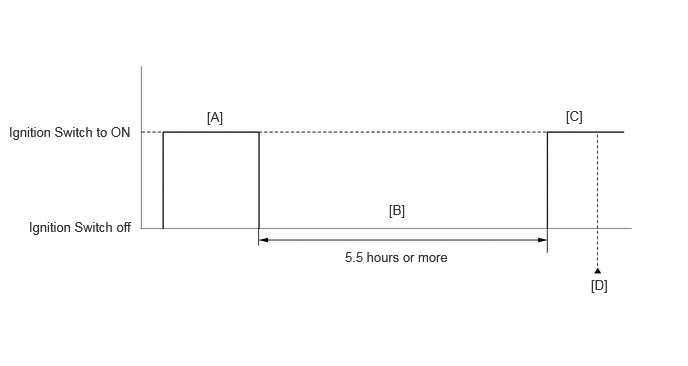
Connect the GTS to the DLC3.
Turn the ignition switch to ON [A].
Turn the GTS on.
Clear the DTCs (even if no DTCs are stored, perform the clear DTC procedure).
Turn the ignition switch off.
With the engine stopped, leave the vehicle as is for 5.5 hours or more [B].
Turn the ignition switch to ON [C].
Turn the GTS on.
Enter the following menus: Powertrain / Engine / Trouble Codes [D].
Read the pending DTCs.
- HINT:
- ·
If a pending DTC is output, the system is malfunctioning.
·If a pending DTC is not output, perform the following procedure.
Enter the following menus: Powertrain / Engine / Utility / All Readiness.
Input the DTC: P012F62.
Check the DTC judgment result.
| GTS Display | Description |
|---|---|
| NORMAL | ·
DTC judgment completed ·
System normal |
| ABNORMAL | ·
DTC judgment completed ·
System abnormal |
| INCOMPLETE | ·
DTC judgment not completed ·
Perform driving pattern after confirming DTC enabling conditions |
- HINT:
- ·
If the judgment result is NORMAL, the system is normal.
·If the judgment result is ABNORMAL, the system is malfunctioning.
·If the judgment result is INCOMPLETE, perform steps [B] through [D] again.
·[B] to [D]: Normal judgment procedure.
The normal judgment procedure is used to complete DTC judgment and also used when clearing permanent DTCs.
·When clearing the permanent DTCs, do not disconnect the cable from the auxiliary battery terminal or attempt to clear the DTCs during this procedure, as doing so will clear the universal trip and normal judgment histories.
CAUTION / NOTICE / HINT
- NOTICE:
- ·
Vehicle Control History may be stored in the hybrid vehicle control ECU assembly if the engine is malfunctioning. Certain vehicle condition information is recorded when Vehicle Control History is stored. Reading the vehicle conditions recorded in both the Freeze Frame Data and Vehicle Control History can be useful for troubleshooting.
(Select Powertrain in Health Check and then check the time stamp data.)
·If any "Engine Malfunction" Vehicle Control History item has been stored in the hybrid vehicle control ECU assembly, make sure to clear it. However, as all Vehicle Control History items are cleared simultaneously, if any Vehicle Control History items other than "Engine Malfunction" are stored, make sure to perform any troubleshooting for them before clearing Vehicle Control History.
- HINT:
-
Read Freeze Frame Data using the GTS. The ECM records vehicle and driving condition information as Freeze Frame Data the moment a DTC is stored. When troubleshooting, Freeze Frame Data can help determine if the vehicle was moving or stationary, if the engine was warmed up or not, if the air fuel ratio was lean or rich, and other data from the time the malfunction occurred.
PROCEDURE
Read the DTCs and record the Freeze Frame Data.
- Powertrain > Engine > Trouble Codes
- 50001 372
- Result:
Result Proceed to DTC P012F62 is output A DTC P012F62 and other DTCs are output B
- HINT:
-
If any DTCs other than P012F62 are output, troubleshoot those DTCs first.
A
B
Using the GTS, read the values displayed in the Freeze Frame Data recorded in step 1.
- Powertrain > Engine > DTC(P012F62) > Freeze Frame Data
-
Tester Display Coolant Temperature Intake Air Temperature - 50040 372 205,214 P012F62
Read the value displayed on the GTS.
- Standard:
GTS Display Specified Condition Difference between the Coolant Temperature and the Intake Air Temperature Within 15°C (27°F)
- HINT:
- ·
When the engine is cold, the value of the engine coolant temperature, engine oil temperature and intake air temperature should be approximately the same.
·If the result is not as specified, check that there are no heat sources such as a block heater in the engine compartment.
·Perform "Inspection After Repair" after replacing the engine coolant temperature sensor.
- Result:
Proceed to OK NG
OK
NG
Using the GTS, read the values displayed in the freeze frame data recorded in step 1.
- Powertrain > Engine > DTC(P012F62) > Freeze Frame Data
-
Tester Display Engine Oil Temperature Sensor Intake Air Temperature - 50040 372 261,214 P012F62
Read the value displayed on the GTS.
- Standard:
GTS Display Specified Condition Difference between the Engine Oil Temperature Sensor and the Intake Air Temperature Within 15°C (27°F)
- HINT:
-
When the engine is cold, the value of the engine coolant temperature, engine oil temperature and intake air temperature should be approximately the same.
- Result:
Proceed to OK NG
OK
NG