M20D-FKS ENGINE CONTROL SFI SYSTEM P20E262 Exhaust Gas Temperature Sensor 1/2 Correlation Bank 1 Signal Compare Failure
DESCRIPTION
The vehicle is equipped with a No. 1 exhaust gas temperature sensor and a No. 2 exhaust gas temperature sensor. The No. 1 exhaust gas temperature sensor and No. 2 exhaust gas temperature sensor each have a built-in thermistor. As the temperature decreases, the thermistor resistance increases and as the temperature increases, the thermistor resistance decreases. The voltages at the respective terminals of the ECM change in accordance with the changes in the resistance of the thermistors. The ECM performs control based on these voltages.
| DTC No. | Detection Item | DTC Detection Condition | Trouble Area | MIL | Memory | Note |
|---|---|---|---|---|---|---|
| P20E262 | Exhaust Gas Temperature Sensor 1/2 Correlation Bank 1 Signal Compare Failure | Both of the following conditions are met (2 trip detection logic):
·
All of the following conditions are met (a)
The battery voltage is higher than 11 V. (b)
The intake air temperature is -10°C (14°F) or higher. (c)
The engine coolant temperature is 75°C (167°F) or higher. (d)
The engine speed is 500 rpm or higher, or less than 5000 rpm ·
Either of following conditions is met: (a)
The GPF upstream exhaust temperature is 355°C (603°F) higher than the GPF downstream exhaust temperature (b)
The GPF downstream exhaust temperature is more than 995°C (1823°F) |
·
No. 1 exhaust gas temperature sensor ·
No. 2 exhaust gas temperature sensor |
Comes on | DTC stored | SAE: P20E2 |
MONITOR DESCRIPTION
When the engine is operating, the ECM monitors the output voltage of the No. 1 exhaust gas temperature sensor and No. 2 exhaust gas temperature sensor. If the difference between the GPF upstream exhaust temperature and the GPF downstream exhaust temperature is outside the normal range or the GPF downstream exhaust temperature is higher than the threshold value, the ECM determines that the No. 1 exhaust gas temperature sensor circuit or No. 2 exhaust gas temperature sensor circuit is malfunctioning and illuminates the MIL and stores a DTC.
CONFIRMATION DRIVING PATTERN
- HINT:
- ·
After repair has been completed, clear the DTC and then check that the vehicle has returned to normal by performing the following All Readiness check procedure.
·When clearing the permanent DTCs, refer to the "CLEAR PERMANENT DTC" procedure.
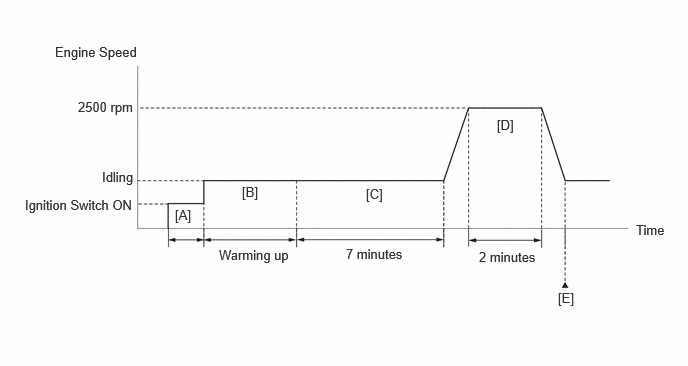
Connect the GTS to the DLC3.
Turn the ignition switch to ON.
Turn the GTS on.
Clear the DTCs (even if no DTCs are stored, perform the clear DTC procedure).
Turn the ignition switch off.
Turn the ignition switch to ON [A].
Start the engine and warm it up until the engine coolant temperature is 75°C (167°F) or higher with all the accessories switched off [B].
Idle the engine for 7 minutes [C].
With the vehicle stationary, depress the accelerator pedal and maintain an engine speed of 2500 rpm for 2 minutes [D].
Enter the following menus: Powertrain / Engine / Trouble Codes [E].
Read the pending DTCs.
- HINT:
- ·
If a pending DTC is output, the system is malfunctioning.
·If a pending DTC is not output, perform the following procedure.
Enter the following menus: Powertrain / Engine / Utility / All Readiness.
Input the DTC: P20E262.
Check the DTC judgment result.
| GTS Display | Description |
|---|---|
| NORMAL | ·
DTC judgment completed ·
System normal |
| ABNORMAL | ·
DTC judgment completed ·
System abnormal |
| INCOMPLETE | ·
DTC judgment not completed ·
Perform driving pattern after confirming DTC enabling conditions |
- HINT:
- ·
If the judgment result is NORMAL, the system is normal.
·If the judgment result is ABNORMAL, the system is malfunctioning.
·If the judgment result is INCOMPLETE, perform steps [B] through [E] again.
·[B] to [E]: Normal judgment procedure.
The normal judgment procedure is used to complete DTC judgment and also used when clearing permanent DTCs.
·When clearing the permanent DTCs, do not disconnect the cable from the battery terminal or attempt to clear the DTCs during this procedure, as doing so will clear the universal trip and normal judgment histories.
CAUTION / NOTICE / HINT
- HINT:
-
Read Freeze Frame Data using the GTS. The ECM records vehicle and driving condition information as Freeze Frame Data the moment a DTC is stored. When troubleshooting, Freeze Frame Data can help determine if the vehicle was moving or stationary, if the engine was warmed up or not, if the air fuel ratio was lean or rich, and other data from the time the malfunction occurred.
PROCEDURE
Read the DTCs.
- Powertrain > Engine > Trouble Codes
- 50001 372
- Result:
Result Proceed to DTC P20E262 is output A DTC P20E262 and other DTCs are output B
- HINT:
-
If any DTCs other than P20E262 are output, troubleshoot those DTCs first.
A
B
Start the engine and warm it up until the engine coolant temperature is 75°C (167°F) or higher with all the accessories switched off.
- Powertrain > Engine > Data List
-
Tester Display Coolant Temperature - 50003 372 205
Idle the engine for 5 minutes or more
Read the value displayed on the GTS.
- Powertrain > Engine > Data List
-
Tester Display Exhaust Temperature B1S1 Exhaust Temperature B1S2 - 50003 372 1133,1134
- Standard:
GTS Display Specified Condition Exhaust Temperature B1S1
Exhaust Temperature B1S2100°C (212°F) to 500°C (932°F)
- Result:
Result Proceed to The values of "Exhaust Temperature B1S1" and "Exhaust Temperature B1S2" are both within range of the standard value A The value of "Exhaust Temperature B1S1" is outside the range of the standard value B The value of "Exhaust Temperature B1S2" is outside the range of the standard value C
A
B
C
Start the engine and warm it up until the engine coolant temperature is 75°C (167°F) or higher with all the accessories switched off.
- Powertrain > Engine > Data List
-
Tester Display Coolant Temperature - 50003 372 205
With the engine warmed up, idle the engine for 5 minutes or more.
While the vehicle is stopped, check the value of the Data List items "Exhaust Temperature B1S1" and "Exhaust Temperature B1S2", and race the engine at 2500 rpm for 60 seconds.
- Powertrain > Engine > Data List
-
Tester Display Engine Speed Exhaust Temperature B1S1 Exhaust Temperature B1S2 - 50003 372 211,1133,1134
- Result:
Result Proceed to The increase in temperature of the value of "Exhaust Temperature B1S1" before and after racing the engine is less than 30°C (54°F) A The increase in temperature of the value of "Exhaust Temperature B1S2" before and after racing the engine is less than 30°C (54°F) B Other than above C
A
B
C