7GR-FKS BATTERY / CHARGING BATTERY WHEN AUXILIARY BATTERY IS DISCHARGED
WHEN AUXILIARY BATTERY IS DISCHARGED
- NOTICE:
-
Never use a quick charger.
- HINT:
- ·
The following problems indicate that the battery is discharged:
-Nothing is displayed on the combination meter even when the ignition switch is turned to ON.
-The engine does not start.
-The headlights are dim.
-The sound from the horn is weak.
·The booster terminal cannot be used to rescue a vehicle with a discharged battery.
for Automatic Transmission:
Set the shift position to P (park) and engage the parking brake.
for Manual Transmission:
Engage the parking brake.
Check that the ignition switch is off.
Remove the engine room relay block and junction block assembly cover.
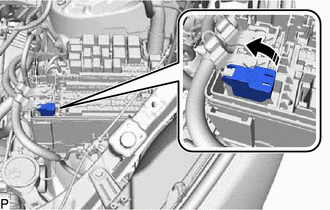

|
Remove in this Direction |
Open the booster terminal cover.
Using booster cables, connect the 12 V battery of the rescue vehicle to the battery of the stalled vehicle as shown in the illustration.

| *a | Booster Terminal | *b | Battery of Rescue Vehicle |
| Connecting Sequence | Connecting Location |
|---|---|
| 1 | Booster terminal of stalled vehicle |
| 2 | Positive (+) battery terminal of rescue vehicle |
| 3 | Negative (-) battery terminal of rescue vehicle |
| 4 | Position shown in the illustration on stalled vehicle |
Start the engine of the rescue vehicle and run its engine a slightly elevated speed for approximately 5 minutes in order to charge the battery of the stalled vehicle.
With the engine of the rescue vehicle maintained at that speed, turn the ignition switch to ON once before starting the engine.
- NOTICE:
-
Once the engine starts, immediately disconnect the booster cable by performing the connection procedure in reverse.