SUPPLEMENTAL RESTRAINT SYSTEMS AIRBAG SYSTEM(for Type B) OPERATION CHECK
PRECAUTION FOR OPERATION CHECK
- CAUTION:
-
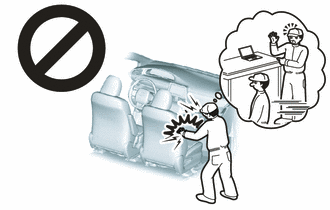
- ·
Be sure to read Precaution thoroughly before servicing.
·Be sure to correctly follow the removal and installation procedures for the SRS parts.
- NOTICE:
-
If there is any damage or deformation of airbag installation components or the areas they are installed to, do not attempt to repair them. Replace the damaged components with new ones.
CHECK SRS WARNING LIGHT
Primary check
Turn the ignition switch to ON and check that the SRS warning light turns on.
Turn the ignition switch off. Wait for at least 2 seconds, and then turn the ignition switch to ON. The SRS warning light comes on for approximately 6 seconds and diagnosis of the airbag system (including the seat belt pretensioners) is performed.
- NOTICE:
-
Turn the ignition switch off when the battery is connected.
- HINT:
- ·
If the warning light remains on for approximately 6 seconds or more after the ignition switch has been turned to ON, there may be a malfunction with the SRS airbag system.
·If the warning light occasionally turns on approximately 6 seconds or more after the ignition switch has been turned to ON, there may be a short to +B, short to ground or an open in the SRS warning light circuit.
·If the warning light illuminates after turning the ignition switch off or ACC, there may be a malfunction in the power source circuit or combination meter assembly.
·The SRS warning light turns off, and then turns on. This blinking pattern indicates a source voltage drop. The SRS warning light turns off 10 seconds after the source voltage returns to normal.
INSPECT AIRBAG COMPONENTS
Inspect the SRS parts in table below.
| Component to Inspect | Procedure |
|---|---|
| Horn button assembly | 1.
Perform a diagnostic system check. 2.
Visually check for defects with the horn button assembly removed from the vehicle.
If any defects are found, replace the horn button assembly or steering wheel assembly with a new one. |
| Lower No. 1 instrument panel airbag assembly | 1.
Perform a diagnostic system check. 2.
Visually check for defects with the lower No. 1 instrument panel airbag assembly removed from the vehicle.
If any defects are found, replace the lower No. 1 instrument panel airbag assembly, No. 1 instrument panel brace sub-assembly or instrument panel reinforcement assembly with a new one. |
| Instrument panel passenger without airbag assembly | 1.
Perform a diagnostic system check. 2.
Visually check for defects with the instrument panel passenger without airbag assembly removed from the vehicle.
If any defects are found, replace the instrument panel passenger airbag assembly, instrument panel safety pad assembly or instrument panel reinforcement assembly with a new one. |
| Front curtain shield airbag assembly | 1.
Perform a diagnostic system check. 2.
Visually check for defects with the curtain shield airbag assembly removed from the vehicle.
If any defects are found, replace the curtain shield airbag assembly with a new one. |
| Rear curtain shield airbag assembly | 1.
Perform a diagnostic system check. 2.
Visually check for defects with the curtain shield airbag assembly removed from the vehicle.
If any defects are found, replace the curtain shield airbag assembly with a new one. |
| Front seat airbag assembly | 1.
Perform a diagnostic system check. 2.
Visually check for defects with the front seat airbag assemblies installed to the vehicle.
If any defects are found, replace the separate type front seatback pad or separate type front seatback cover with cover with a new one. 3.
Visually check for defects with the front seat airbag assemblies removed from the vehicle.
If any defects are found, replace the front seat airbag assembly with a new one. |
| Front seat outer belt assembly | 1.
Perform a diagnostic system check. 2.
Visually check for defects with the front seat outer belt assembly removed from the vehicle.
If any defects are found, replace the front seat outer belt assembly with a new one. |
| Rear seat outer belt assembly | 1.
Perform a diagnostic system check. 2.
Visually check for defects with the rear seat outer belt assembly removed from the vehicle.
If any defects are found, replace the rear seat outer belt assembly with a new one. |
| Airbag ECU assembly | 1.
for Airbag that has not Deployed: (a)
Perform a diagnostic system check. (b)
Visually check for defects with the airbag ECU assembly installed to the vehicle.
If any defects are found, replace the airbag ECU assembly with a new one. 2.
for Airbag that has Deployed: (a)
Replace the airbag ECU assembly.
|
| Front airbag sensor | 1.
When airbags have deployed as the result of a collision, be sure to replace all airbag sensors in the damaged areas (anywhere in need of repair). 2.
Visually check the airbag sensors in undamaged areas for defects.
If any defects are found or an airbag sensor has detected a major collision, replace the airbag sensor with a new one. 3.
Perform a diagnostic system check. |
| Side airbag pressure sensor | |
| No. 1 side airbag sensor | |
| No. 2 side airbag sensor | |
| No. 3 side airbag sensor | |
| Harness and connector | 1.
Perform a diagnostic system check. 2.
Check any wire harnesses in exposed contact with the airbag wire harness for damage. 3.
Check the connector of the airbag wire harness for scratches, cracks or damage. |