M20F-FXS, M20G-FXS ENGINE CONTROL SFI SYSTEM P24507E Evaporative Emission System Switching Valve Actuator Stuck On P24517F Evaporative Emission System Switching Valve Actuator Stuck Off
DTC SUMMARY
| DTC No. | Detection Item | DTC Detection Condition | Trouble Area | MIL | Note |
|---|---|---|---|---|---|
| P24507E | Evaporative Emission System Switching Valve Actuator Stuck On | Either of the following conditions is met when fuel tank pressure is higher than -2 kPa(gauge) [-0.3 psi(gauge)], and less than 3 kPa(gauge) [0.4 psi(gauge)].
·
Fuel tank pressure change when vacuum introduction for canister is higher than 0.5 kPa [0.07 psi] ·
EVAP pressure when vacuum introduction for canister was complete is higher than (third reference pressure x 0.2) |
·
Fuel vapor-containment valve ·
Connector/wire harness (fuel vapor-containment valve - ECM) ·
ECM |
Comes on | SAE Code: P2450 |
| P24517F | Evaporative Emission System Switching Valve Actuator Stuck Off | Either of the following conditions is met:
·
Fuel tank pressure change when vacuum introduction for canister is less than 0.5 kPa [0.07 psi] ·
EVAP pressure change when fuel vapor-containment valve is open is less than 0.9 kPa [0.1 psi] |
·
Fuel vapor-containment valve ·
Connector/wire harness (fuel vapor-containment valve - ECM) ·
ECM |
Comes on | SAE Code: P2451 |
| DTC No. | Monitoring Item | Detection Timing | Detection Logic | SAE Code |
|---|---|---|---|---|
| P24507E | Fuel vapor-containment valve stuck open | EVAP monitoring
(ignition switch off) |
2 trip | P2450 |
| P24517F | Fuel vapor-containment valve stuck closed | P2451 |
DESCRIPTION
Refer to EVAP (Evaporative Emission) System.
MONITOR DESCRIPTION
P24507E: Fuel vapor-containment valve stuck open
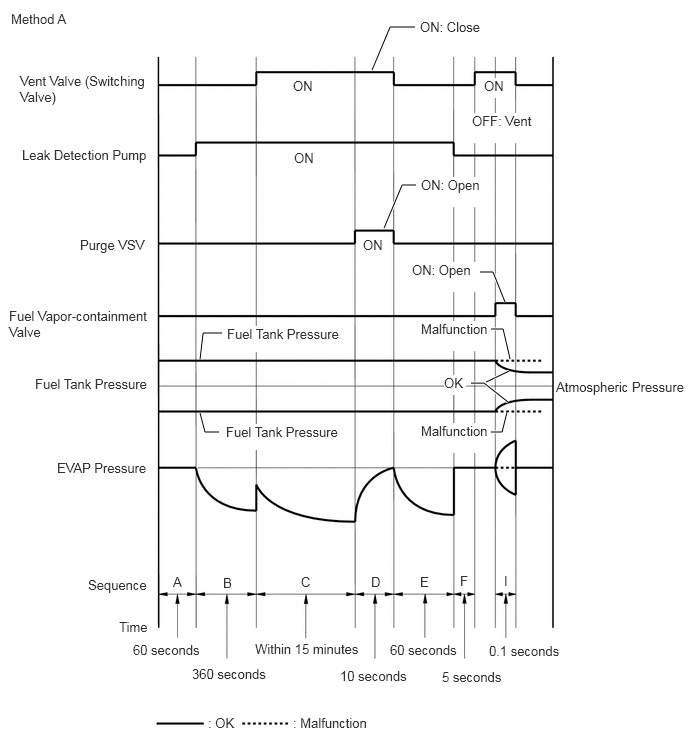
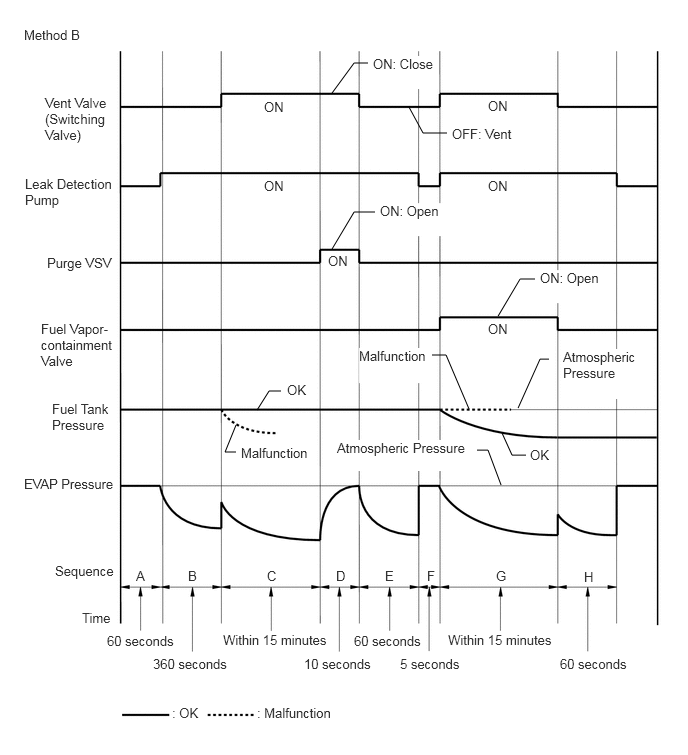
During sequence C, the leak detection pump creates vacuum in the EVAP system. If the pressure in the fuel tank drops, the ECM determines that the fuel vapor-containment valve is stuck open, illuminates the MIL and stores the DTC (2 trip detection logic).
P24517F: Fuel vapor-containment valve stuck closed (vent)
During sequence I, the fuel vapor-containment valve opens to allow atmospheric pressure into the fuel tank. If there is no change in fuel tank pressure, the ECM determines that the fuel vapor-containment valve is stuck closed, illuminates the MIL and stores the DTC (2 trip detection logic).
During sequence G, the fuel vapor-containment valve opens to allow vacuum pressure generated by the leak detection pump into the fuel tank. If the pressure in the fuel tank does not drop, the ECM determines that the fuel vapor-containment valve is stuck closed, illuminates the MIL and stores the DTC (2 trip detection logic).
MONITOR STRATEGY
| Required Sensors/Components | Fuel vapor-containment valve
Fuel tank pressure sensor Canister pump module |
| Frequency of Operation | Once per driving cycle |
CONFIRMATION DRIVING PATTERN
- NOTICE:
- ·
The Evaporative System Check (Automatic Mode) consists of 9 steps performed automatically by the GTS. It takes a maximum of approximately 40 minutes.
·Do not perform the Evaporative System Check when the fuel tank is more than 90% full because the cut-off valve may be closed, making the fuel tank leak check unavailable.
·Do not start the engine during this operation.
·When the temperature of the fuel is 35°C (95°F) or higher, a large amount of vapor will from and any check result will be inaccurate. When performing the Evaporative System Check, keep the fuel temperature less than 35°C (95°F).
- HINT:
- ·
After repair has been completed, clear the DTC and then check that the vehicle has returned to normal by performing the following All Readiness check procedure.
·When clearing the permanent DTCs, refer to the "CLEAR PERMANENT DTC" procedure.
Connect the GTS to the DLC3.
Turn the ignition switch to ON.
Turn the GTS on.
Clear the DTCs (even if no DTCs are stored, perform the clear DTC procedure).
Turn the ignition switch off and wait for at least 30 seconds.
Turn the ignition switch to ON [A].
Turn the GTS on.
Enter the following menus: Powertrain / Engine / Utility / Evaporative System Check / Automatic Mode [B].
After the "Evaporative System Check" is completed, check for All Readiness by entering the following menus: Powertrain / Engine / Utility / All Readiness.
Input the DTC: P24507E or P24517F.
Check the DTC judgment result.
| GTS Display | Description |
|---|---|
| NORMAL | ·
DTC judgment completed ·
System normal |
| ABNORMAL | ·
DTC judgment completed ·
System abnormal |
| INCOMPLETE | ·
DTC judgment not completed ·
Perform driving pattern after confirming DTC enabling conditions |
- HINT:
- ·
If the judgment result is NORMAL, the system is normal.
·If the judgment result is ABNORMAL, the system is malfunctioning.
·[A] to [B]: Normal judgment procedure.
The normal judgment procedure is used to complete DTC judgment and also used when clearing permanent DTCs.
·When clearing the permanent DTCs, do not disconnect the cable from the auxiliary battery terminal or attempt to clear the DTCs during this procedure, as doing so will clear the universal trip and normal judgment histories.
CAUTION / NOTICE / HINT
- NOTICE:
- ·
Vehicle Control History may be stored in the hybrid vehicle control ECU assembly if the engine is malfunctioning. Certain vehicle condition information is recorded when Vehicle Control History is stored. Reading the vehicle conditions recorded in both the Freeze Frame Data and Vehicle Control History can be useful for troubleshooting.
(Select Powertrain in Health Check and then check the time stamp data.)
·If any "Engine Malfunction" Vehicle Control History item has been stored in the hybrid vehicle control ECU assembly, make sure to clear it. However, as all Vehicle Control History items are cleared simultaneously, if any Vehicle Control History items other than "Engine Malfunction" are stored, make sure to perform any troubleshooting for them before clearing Vehicle Control History.
PROCEDURE
- Result:
Proceed to NEXT
NEXT